
@FlameRaptorRaven

The Tortured Genius's World Cup Odyssey
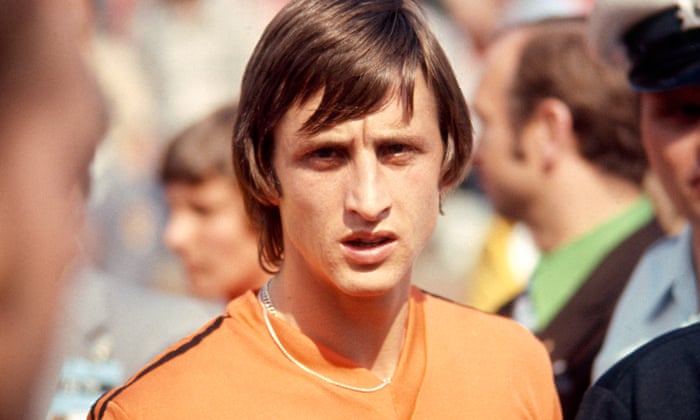
Johan Cruyff is both one of football’s greatest players and one of the game’s greatest minds ever. He is widely considered the Netherlands’ greatest player ever. His playmaking was revered, and he was the driving force of Total Football. What’s Total Football? A system where every outfield player can cover multiple spots. Need a striker to fill in the midfield? They can do that. Winger at fullback? No problem. Left back to left mid? You should know the answer. Even though Cruyff was a forward, his passing, speed and intelligence made him perfect for this system. He turned it from fascinating to unstoppable, leading Dutch club Ajax to a Champions League 3-peat in the early 70s. He even has a skill move named after him, the Cruyff turn.
The Flying Dutchman was a phenomenal player who won 3 Ballon d’Ors, but what he did off the pitch may be even more impressive. He convinced Barcelona to open La Masia. He pushed for the academy to prioritize technical skill and intelligence over pure athleticism. He brought Total Football to Spain and, as manager, turned them into the Dream Team, helping them win their first-ever Champions League in 1992. He is the godfather of everything that keeps Barcelona one of the biggest clubs in the world today.
In the words of Pep Guardiola, "Johan Cruyff painted the chapel. And Barcelona coaches since merely restore or improve it.”
Despite all his greatness, Johan Cruyff never won a World Cup, even though his nation qualified for both the 1974 and 1978 World Cup Finals, during Cruyff’s peak as the best player of the 70s. How on earth did such a brilliant player and mind not win the World Cup? The answer is dumber and scarier than you think.
In 1974, Cruyff was the best player on the planet. He captained the Dutch squad through a dominant World Cup performance. Entering the Final, they scored the 2nd most goals and conceded the least. They were coming off a 4-1 victory against Argentina and a 2-0 victory against defending champions Brazil. Cruyff scored 3 of the Netherlands’ 6 combined goals in those games. Although their opponent was the robust West Germany led by the all-time duo of Franz Beckenbauer and Gerd Müller, the Netherlands was the favourite going in. After all the success Total Football had at club level, now was the perfect time for the tactic to reach its peak on the biggest stage. As long as nothing crazy happens…
On the day before the Final, German newspaper Bild Zeitung published an exposé article on the Dutch national team claiming they were engaged in a naked poolside orgy with the headline “Cruyff, Champagne and Nude Women” in German. With the World Cup being in Germany, the story took off and sent shockwaves through the orange men. Dutch midfielder Arie Haan remembers Johan Cruyff running to the team and shouting “We have a major problem!”
A crucial factor in sparking the media firestorm was that the newspaper did not reveal any of the names involved. Instead, it said there were 4 unnamed Dutch players while providing photos of players hanging out with local women. This decision allowed speculation to run rampant as any player on the team could potentially be involved. It also helped that the newspaper teased their "damning evidence" while intentionally withholding it. Reporters quickly swarmed the Dutch national team at the first opportunity, pestering them with questions about the situation.
The players and their manager, Rinus Michels, immediately denied that the story was true. Those rejections were brushed aside as unconvincing and did not stop the information from being passed onto the wives of the players, which led to them furiously calling them and demanding to know if they had cheated. One of those wives was Diana "Danny" Coster, Johan Cruyff’s wife. Cruyff apparently stayed on the phone all night trying to reassure her that he had not cheated.
How on earth was the German newspaper able to so confidently make their claims? Simple: they orchestrated it.
It has since been revealed that Bild Zeitung bribed the hotel’s security to let them bring in beautiful German women in bikinis to sit by the pool before the Netherlands’ game against Brazil (the game before the Final) and seduce the players. Clearly they succeeded because the players continued to party with them after the game, which is when the paper’s photographer snagged some candid photos and a few days later, the paper dropped the story. Cruyff’s name was intentionally used to stoke the flames of controversy, even though it is generally believed he was not involved in any kind of sexual activity. The team's manager has tried to downplay the effect the story had on the team, but some players have spoken about this situation plainly.
“We read the article and were taken aback and bewildered. It was our first encounter with such journalism. Undoubtedly, this story had an impact on the team and shifted our perspective. Previously, we paid no attention, but now we comprehend the realities of fame. Tension surfaced, and our spouses incessantly rang the hotel.” - Arie Haan
The consensus is that the entire Dutch squad was sleep-deprived heading into the Final, but once the game finally started, it seemed like it wouldn’t matter. Cruyff almost immediately drew a penalty and Johan Neeskens converted it to give the Dutch a 1-0 lead. Retellings of this game have described the Netherlands’ play in the Final as arrogant and aggressive. You may assume that is because of the aforementioned bombshell article, and it is, but there’s another reason: World War 2.
Remember, WW2 ended less than 30 years ago, in 1974. The Netherlands still had fresh wounds due to being taken over by the Germans before being liberated by Canada in 1945. Virtually every player on the Dutch squad had a family member who had experienced the horrors of war firsthand. One of those players was Willem van Hanegem, whose father was killed while protecting Hanegem when he was a baby, along with his brothers and sister. Even without the mess before this game, the Dutch had every reason to want to embarrass the West Germans. Unfortunately, the lingering animosity, lack of sleep and constant anxieties caught up to them.
West Germany won their own penalty and scored it to tie the game. After that, Gerd Müller scored right before halftime to give West Germany a 2-1 lead. The Dutch never recovered, and West Germany won the World Cup. Johan Cruyff’s performance has been described as below his standard. The usually-composed talisman notably lost his temper more than once. It is widely believed that the Netherlands would’ve won if that exposé had not been released before the Final.
To rub salt into the wound even more and convince you that this was orchestrated in some way, the German newspaper decided not to publish the "damning evidence" they had of the Dutch players. No defamation lawsuit was filed by the Dutch, and for some, that is all the evidence they needed on whether the orgy really happened. No matter what actually happened, the 1974 Netherlands national team is one of the best teams ever to not win the World Cup.
A heartbreaking ending, but Johan Cruyff would only be 31 in 1978. Total Football remains a revolution, and the Dutch should still be strong. As long as nothing crazier happens, they’ll have another chance in 4 years.
The 1978 World Cup is the most infamous tournament in the competition's long history. It was set to take place in Argentina, and if you thought that FIFA holding tournaments in dubious places was a new thing, buckle up.
The 1960s and 70s were an extremely tumultuous time for Argentina, marked by multiple military coups and details that would take far too long to explain. For the sake of our story, one of those coups happened in 1976, and since Argentina had already been set to host the World Cup, the world’s largest and most important tournament was about to be held in a country ruled by a military dictatorship. The Military Junta (a group of military leaders) was not above using the World Cup as propaganda.
Meanwhile, Johan Cruyff and the Netherlands were still rolling. While Cruyff was no longer at his absolute peak, he was still elite. He had since joined Barcelona and made them contenders for LaLiga while helping his national team finish 3rd in the European Championship in 1976. He continued wreaking havoc in the World Cup qualifiers, helping his nation dominate their group and easily qualify. Just when everything seemed to be going smoothly, an announcement shook the football world.
Johan Cruyff, who had retained the title as the best Dutch player on Earth, announced he was pulling out of the World Cup and retiring from international football. The Netherlands was devastated by this news as many believed they could never win the World Cup without The Flying Dutchman. Cruyff’s reluctance to reveal why he decided to do this led to multiple theories. Some believed Cruyff was protesting the decision to hold the World Cup in Argentina by sitting out, while others blamed Cruyff’s wife Danny, suggesting she had convinced him to not play in the wake of the ‘pool orgy’ incident.
The wife-theory was actually the most popular and led to a ton of unfair criticism laid upon Danny. Cruyff remained silent about it until a former Barcelona teammate, Carles Rexach, wrote in his book that Cruyff's family stopped him from competing in the 1978 World Cup.
Cruyff kept it a secret until 30 years later, in 2008, the same year Rexach published his book, and the real reason is more horrifying than you think.
Cruyff revealed that he, his wife and his children had been kidnapped in 1977. That is not a typo. CRUYFF, HIS WIFE AND HIS CHILDREN WERE KIDNAPPED. At the very least, people attempted to kidnap him and nearly succeeded. According to the man himself, in late 1977, men broke into his apartment in the middle of the night, tied up both him and his wife in front of their kids and held a rifle to Cruyff’s head.
“I had a rifle at my head, I was tied up, my wife tied up, the children were in the apartment in Barcelona” - Johan Cruyff, 2008
Although Cruyff did not reveal how that incident ended, we know nobody perished. While that was a relief, this situation rattled Cruyff. His kids started attending school with bodyguards, and his apartment now had round-the-clock security. It altered his priorities. He couldn't go compete in the biggest tournament of his life while the safety of his family was on his mind.
"To play a World Cup you have to be 200%," said Cruyff. "There are moments when there are other values in life."
Shockingly, even without Cruyff, the Netherlands still made it all the way to the World Cup Final, granted, in a run that paled in comparison to the dominant 1974 squad. Still, just like back then, they lost the Final 3-1 to Argentina. Many strongly believe that the Dutch would have won the World Cup if they had Cruyff. The Flying Dutchman never played for the Netherlands again. Considering… everything, it is possible that Argentina conspired to kidnap Cruyff and his family. However, this is purely speculation on my part, and there is no evidence that it was the case. But also… come on.
Cruyff actually briefly retired from football altogether before venturing to the USA and joining the Los Angeles Aztecs in the North American Soccer League in 1979 (where he won MVP in his first season). He spent another year in America before returning to Spain, then the Netherlands and retiring as a player to begin his legendary management career.
Johan Cruyff is one of the greatest players to not win the World Cup, but his legacy is so much more than ‘just’ one of the greatest players ever. He is possibly the greatest mind the game has ever seen. His influence remains ever-present in today's game, with most of the best teams using Cruyff as a foundation. German football legend Philipp Lahm has pointed out that Cruyff's influence remains strong in the way Spain approaches coaching and youth development across the nation as well as in Barcelona. Ironically, the Flying Dutchman is Spain's greatest football visionary.
If you somehow still don’t believe the hype, I have 1 quick story for you.
When Cruyff was hired to be Barcelona’s manager in 1988, he went down to La Masia, the academy he convinced Barcelona to start, and watched the youth game. At halftime, Cruyff found his way into the dugout and spoke to Barcelona’s youth team coach, Carles Rexach. Cruyff immediately asked about the kid playing right midfield. Rexach described that player as a ‘good lad’ before Cruyff cut him off and suggested moving him to the center of the midfield in a pivot role. The pivot role is often thought of as one of the most challenging positions to play, but considering Cruyff’s pedigree, Rexach did what he asked. The ‘good lad’ immediately thrived, just as Cruyff predicted.
That player was Pep Guardiola. A couple of years later, Cruyff called up Pep to Barcelona’s lineup before he turned 20. Two years after that, Pep played a crucial role in Barcelona’s Dream Team that won the Champions League in 1992.
Pep still credits Cruyff with teaching him everything he knows about football.
"I knew nothing about football before knowing Cruyff," - Pep Guardiola, 2016, in the wake of Cruyff’s death from lung cancer.
"Nobody is like Johan! It's a big compliment to say that, but nobody is like him; the charisma, personality.
He changed the mentality of two clubs - Ajax and Barcelona - as a player and manager. A charisma that's impossible to replicate, self-confidence, many, many aspects that he had. It's impossible!" - Pep Guardiola in 2026 when asked if he wants to be remembered as the Johan Cruyff of Manchester City.
10
0
Replies: