
@FlameRaptorRaven

Why we have the Final Group Stage Game Rule
If you're looking at the schedule, you likely notice that the final group games all take place at the same time. For example, Switzerland-Canada and Bosnia-Qatar start at the exact same time to finish Group B. You may be wondering why that is the case. Is it for the sake of meeting the time constraints? Nope. Is it for the drama? Not really. Is it because FIFA wants infinite money? True, but not the reason in this case. It's for a special reason, because a couple of dastardly teams tried to cheat the old system.
In the first 50 years of World Cups, this rule didn’t exist. It worked out like you probably imagine, normal scheduling all the way through. This was the case heading into the 1982 World Cup in Spain. This tournament was the first to expand to 24 teams (from 16 in 1978). Therefore, multiple new teams qualified for the first time ever; Algeria was one of them.
Algeria only became independent from France in the early 60s, but didn’t join FIFA until 1964. As you can imagine, football wasn’t at the top of their priorities after gaining independence, but they did manage to qualify for the 1968 Africa Cup of Nations (AFCON) by steamrolling their qualification group. They went on to beat Uganda for their first-ever competitive win, but couldn’t escape the group stage. They missed out on the next 5 AFCONs. World Cups were a similar but more depressing story. Algeria withdrew from qualification for the 1966 edition before failing to qualify for 1970, 1974, and 1978. But in 1980, there was a breakthrough.
(Algeria's captain shaking hands with Nigeria's captain before the 1980 AFCON Final)
Algeria qualified for the 1980 AFCON and went on a magical run. Behind a strong defence and clutch goalscoring, Algeria made it all the way to the Final before being demolished by the tournament’s host, Nigeria. Algeria didn’t let this setback throw them off as they went on to crush qualification for the 1982 World Cup. They did it while beating each of their opponents by 2+ goals, including Nigeria in the final round, whom they beat 4-1. They were no fluke. With only two teams from Africa qualifying for the World Cup, they were truly the cream of the crop and had a real case as the best team in Africa. That didn’t stop their first opponent from overlooking them. In Algeria’s first-ever World Cup game, they had to face the monster known as West Germany.
In the wake of World War 2, Germany was split in 2 by the Berlin Wall, forcing the nation to have 2 national teams, West Germany and East Germany. West Germany had emerged as the far superior side, winning the World Cup in 1954 and continuing to dominate after that. West Germany was the reigning Euro champion; they had finished runner-up in 1976 and won it back in 1972. They won the World Cup back in 1974. They had dominated their qualifiers, winning all 8 games and averaging 4 goals per game. Even with all-time greats like Franz Beckenbauer and Gerd Muller no longer around, West Germany looked unstoppable and the best team not just in Europe but in the world. West Germany was not lacking for confidence. One player infamously said, in reference to their upcoming game against Algeria, “We will dedicate our seventh goal to our wives, and the eighth to our dogs,” while the manager, Jupp Derwall, proclaimed he’d jump on the first train back to Munich if they lost to Algeria.
Unfortunately for them, Algeria was very familiar with being an underdog. Algeria scored first. West Germany matched it, only for Lakhdar Belloumi to score right after. That goal proved to be the winner as Algeria did the unthinkable and upset a European giant in their first-ever World Cup match in a historic moment for a young nation. Belloumi later called it “the finest moment of my career”. For him, once thought of as Algeria’s greatest-ever player (until Riyad Mahrez happened), this moment meant everything.
(Belloumi screaming in celebration after scoring against West Germany)
Algeria took a step back when they lost to Austria, but bounced back by beating Chile, giving them 4 points (wins were worth 2 back then). With Algeria’s group games finished, they were in the driver's seat. They could watch West Germany-Austria with some comfort, knowing that only a specific result would eliminate them.
West Germany recovered from their humiliation by beating Chile 4-1 in their next game, while Austria had total control of the group after beating that same team 1-0. Heading into the final game, everyone knew the stakes. If Austria won or tied, Algeria would advance to the next stage. If West Germany won by 3 or more goals, Algeria would move on to the next round. The only way Algeria could be eliminated is if West Germany won by 1 or 2 goals. Keep in mind that West Germany and Austria were fierce rivals, so each team had all the incentive it needed to do everything in its power to destroy the other team’s chances at a World Cup. Well, not quite all the incentives.
Algeria played their final group game on June 24th, 1982; West Germany-Austria was scheduled for the next day. The game played out very… interestingly. West Germany scored within the first 10 minutes, and then… nothing. Stats for this game are really hard to find, but every account claims both teams just relaxed for the next 80+ minutes. Every retelling claims that both sides weren’t even trying after that first goal was scored. The few stats I could find claimed Austria completed 99% of their passes on their side of the pitch (think about that). You can look up the footage and see exactly what they mean. Nobody was pressing; it looked as if every pessimistic interpretation of football had come to life. In case you somehow don’t find this suspicious, some German coaches sent apology letters to Algerian officials.
(The only goal in the match)
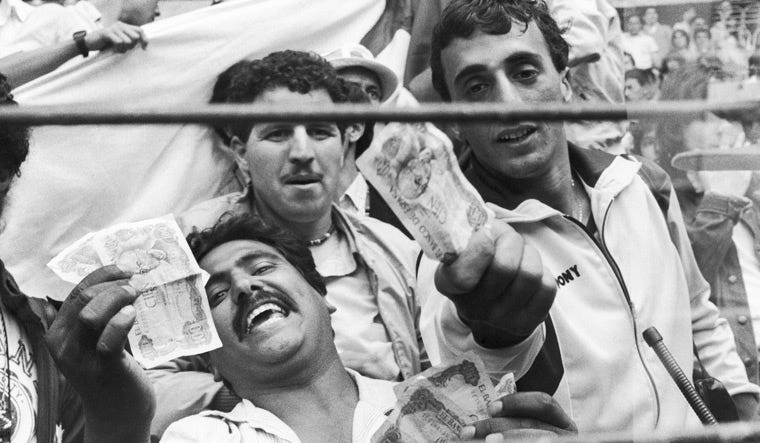
It quickly became apparent what was happening: West Germany and Austria were conspiring to advance to the next round while eliminating Algeria. Algerian fans booed while burning money in the stands. Spanish fans in attendance were similarly incensed and joined in, waving handkerchiefs in a showing of disgust. Then there were the chants. The Spaniards gave us “Que se besen!” (Let them kiss). Then followed that up with “Fuera! Fuera!” (Get out! Get out!). Just in case people weren’t sure whose side they were on, they also added: “¡Argelia, Argelia!” (Algeria! Algeria!) for good measure. Any bills that weren’t burned were waved in the air by Algerian supporters. It wasn’t just the fans; even the commentators were outraged.
(Algerian fans waving money)
Ironically, in a showing of unity, both Germans and Austrians were livid. Eberhard Stanjek, commentating for West Germany, nearly cried in his booth, proclaiming, "What is happening here is disgraceful and has nothing to do with football. You can say what you like, but not every end justifies the means." The Austrian commentator begged viewers to turn off the channel, then remained silent for the rest of the match. The fans were with them, and a West German fan burned his flag.
(West Germany and Austria after the game ended)
When the game ended, Algerian fans tried to storm the field, only to be stopped by security. The game became known as the Disgrace of Gijón. The Spanish newspaper El Comercio (Gijón’s local paper) famously placed the match report in the crime section under the headline “40,000 people are scammed by 26 Austrian and German citizens”. Even a former German player, Willi Schulz, called the Germans “gangsters” for their actions. Despite everything, neither team showed any signs of regret.
(Best I can find of the actual article)
Jupp Derwall played dumb and said, “We had the perfect right to be careful in this game in order to get into the second round of the World Cup.” Austria’s manager, Hans Tschak, went a step further and accused the “sons of the desert” of stirring something up that wasn’t there. “Naturally, today's game was played tactically. But if 10,000 'sons of the desert' here in the stadium want to trigger a scandal because of this, it just goes to show that they have too few schools. Some sheikh comes out of an oasis, is allowed to get a sniff of World Cup air after 300 years and thinks he's entitled to open his gob.” Don’t worry, the players joined in pissing everyone off. Midfielder Wolfgang Dremmler said, "I can't care about the crowd's reaction. They fly here to watch the game at their own risk," in a post-match interview. When German fans showed up at the team hotel to protest their actions, the players threw water balloons at them from the balcony.
Basically, everyone except the players and managers was begging FIFA to punish them in some way. In typical FIFA fashion, they did nothing, claiming no rules were broken. They conveniently changed the rules immediately after the tournament so that the final games of a group must be played on the same day at the same time. Not suspicious at all.
(The 1982 Algeria Squad)
You may be wondering what the Algerian players, coaches and Football Federation (FA) thought of this. You may be surprised to know that some of them weren’t mad, or at least not as mad as you may think. Chaabane Merzekane, one of Algeria’s centre-backs, said, “We weren't angry, we were cool. To see two big powers debasing themselves in order to eliminate us was a tribute to Algeria. They progressed with dishonour, we went out with our heads held high.” He’s not alone in this thought process. Ben Alli Sekkel, president of Algeria’s FA, has said: “It is an honor for Algeria that Germans and Austrians had to form a pact to be able to eliminate us.”
Perhaps they have a point.
Austria went on to lose in the second group stage (yes, there were 2 back then) while West Germany made it all the way to the Final before getting pummeled by Italy. Had one of them won the World Cup, the world may have exploded.
If you’re wondering how Algeria feels decades later, well, in 2014, at the World Cup in Brazil, Algeria played Germany in the round of 16, their first-ever knockout game at the World Cup. Algeria’s manager at the time, Vahid Halilhodzic, made it a point to talk about 1982, claiming that nobody had forgotten what happened. Sadly, in a cruel act from the football gods, Germany beat Algeria 2-1 in extra time, then went on to win the World Cup. That round-of-16 loss is the only time Algeria has ever lost to Germany. However, with the power of hindsight, I believe Algeria can take some solace from 1982. They have the ultimate trump card, so good that they forced a rule change.
I will leave you with the words of Lakhdar Belloumi:
“Our performances forced FIFA to make that change, and that was even better than a victory. It meant that Algeria left an indelible mark on football history.”
(Belloumi is known as The Wizard of Maghreb)
11
0
Replies: